First campaign
Your First Adult Traffic Campaign, Step by Step
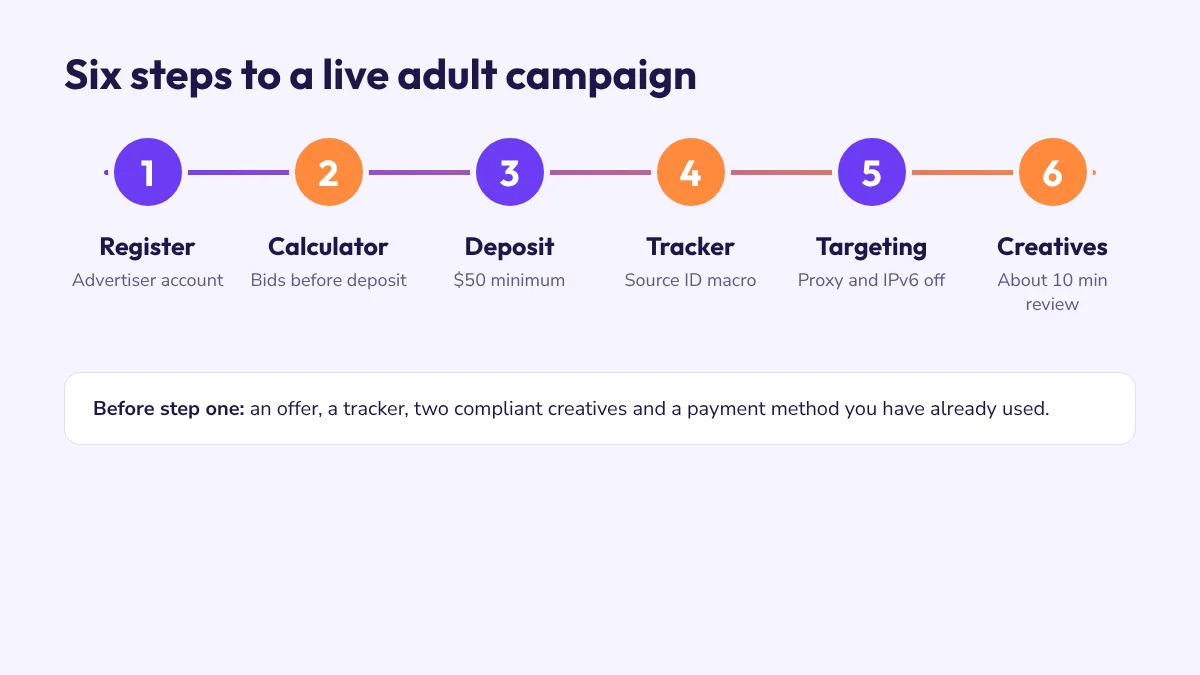
Register an advertiser account, check the Traffic Calculator, fund the balance, connect your tracker, set targeting and submit creatives: that is the whole launch sequence, in that order. The launch itself is the short part: AdsCompass lets you buy adult traffic once a $50 deposit clears on any payment method. Preparation decides whether the first test teaches you anything.
AdsCompass at a glance
What to Have Ready Before You Register
Four things should exist before signup: an offer, a tracker, compliant creatives and a payment method you have already used. Hunting for any of them after the account is funded is where first launches lose days.
- An offer and landing page that load fast on mobile and desktop, with the destination URL checked on VirusTotal.
- A tracker account. Keitaro, Binom, Voluum and RedTrack connect through S2S postback templates; CPV Lab and CPV One have documented step-by-step integration.
- Two or three creatives written to the rules. Explicit material and iGaming are allowed; violence, weapons and drugs are not.
- One GEO, one format and one device type picked for the test.
Dating needs its own test. AdsCompass runs dating with separate inventory and bid levels, so budget it as its own campaign instead of folding it into an adult one.
Decide the goal before you start, too. The Traffic Calculator changes its recommendations depending on whether you want maximum volume or the cheapest clicks, and you should know which one you are buying before you set a bid.
Six Steps From Signup to Live Campaign
Six steps take you from an empty account to a campaign in moderation. Do them in order, because each depends on the one before.
- Register as an advertiser. Sign up on adscompass.com on the advertiser side. Advertiser and publisher accounts are separate, with separate dashboards, so monetizing your own sites means a second registration later.
- Check the Traffic Calculator. It opens after free registration, before any deposit. Filter by GEO, format and mobile, desktop or combined, then note volume and average CPC. The figures follow completed auctions, so that average is your starting bid reference.
- Deposit from $50. The minimum is the same on every rail, from Capitalist, USDT TRC-20 and BTC to PayPal, Stripe, cards, Apple Pay, Google Pay, Paxum, WebMoney and bank wire. Balances are held in USD.
- Connect the tracker and pass the source ID macro. Use the documented setup or the S2S postback template, and allow about an hour for the postback. Pass click ID, campaign ID, creative ID, price and source ID. Skip the source ID and you cannot tell which site sold you which conversion. Fire a test conversion before you spend a cent.
- Set targeting and exclusions. Choose GEO, device, OS and browser with versions, connection type and browser language. Switch on proxy and IPv6 exclusion, which filters before the impression is bought, add a frequency cap per unique IP per day and pick even 24-hour spend. Buy run-of-network for this test.
- Submit creatives. Moderation takes about ten minutes, longer on edge cases. Most rejections come from a breach of terms, a link entered incorrectly or a destination URL with many VirusTotal alerts, so recheck the link field before you submit.
How Much to Put Behind the First Test
Around $500 is my recommendation for a test that should rank sources. The $50 minimum only opens the account. It proves your tracker, postback and creatives work, but split across every source ID the campaign touches, it leaves too few clicks per site to separate good from bad.
Daily cap equals budget divided by test days. A $500 test over five days gets a $100 cap; over seven days, about $71. Keep even spend on and the money covers every hour of every day instead of whichever hours come first.
Run the click arithmetic before you commit. Purely as an example, $500 at $0.002 per click buys 250,000 clicks, and at $0.02 it buys 25,000. Swap in the average CPC the Calculator shows for your GEO and format.
| Test budget | Daily cap over 5 days | What it lets you judge |
|---|---|---|
| $50 | $10 | Tracker, postback and moderation work |
| $200 | $40 | Whether the offer converts at all |
| $500 | $100 | Which source IDs to cut or keep |
Keep the budget in one campaign, one GEO and one format. Two creatives can share it. Two GEOs cannot.
What to Watch in the First 72 Hours
Tracking accuracy comes first, then pacing, then sources. A source report built on broken tracking is worthless.
First six hours
Click counts should roughly match between the AdsCompass report and your tracker. A large gap usually means a broken redirect or a slow landing page. Open a few click records and confirm the source ID field holds a real value, not raw macro text, and that postbacks arrive with the right click ID. No spend at all usually means the bid is too low, since a minimum bid is accepted but not competitive.
Days one and two
Pacing tells you whether bid and cap fit together. With even spend on, a campaign far below its daily cap is losing auctions. Raise the bid once and leave it for several hours. Changing bid, targeting and creative on the same day makes the data unreadable.
Day three
Sources are the day-three job. AdsCompass reports show what each site delivered and your tracker shows what it converted, so join the two on source ID. Sources that took a real share of spend with zero conversions go on a blacklist. Converters go on a list you can later whitelist or bid up with source ID bidding, which is as far as scaling goes in a first test.
Fallbacks to Prepare Before Launch
Three backups belong in place before launch: an approved spare creative, a second GEO and a second payment rail. Each covers a failure that would otherwise stop the campaign while you fix it.
An approved backup creative saves a moderation cycle. Submit it with the main one in step six, then pause it. If the main creative gets rejected after an edit or fades, you swap in something already cleared.
A second GEO protects you from regulation. A new age-verification law can wipe out a country's inventory the day it starts applying, and VPN use rises where age checks apply. Build the second campaign in advance, check its volume in the Calculator and keep it paused. Unsure about local rules on adult advertising there? Ask a lawyer in that jurisdiction before switching it on.
A second payment rail keeps the balance from hitting zero. The $50 minimum is identical on every method, so a backup costs nothing extra to set up. Pair a card with USDT TRC-20, and a declined charge will not pause delivery mid-test.
Where to Get Help
Your personal manager is the first call. AdsCompass assigns one to every account, and the manager handles anything outside the self-serve dashboard, such as reserved placements and negotiated rates.
Telegram support runs around the clock in English and Russian. Use it for anything that blocks launch: a postback that will not fire, a rejection you do not understand, a deposit that has not landed. Put the campaign ID and creative ID in your first message so nobody has to ask.
GoldLead CPA offers sit inside the same advertiser account if you have no offer yet. Ask your manager which ones fit your test GEO, then go back to the prep list.